By LALIT K JHA and BA KAUNG
The US government said it is “consulting” with its international partners, as well as key global and regional players, on the subject of creating an international commission to investigate alleged war crimes by the Burmese military junta, the White House said on Wednesday.
“We have begun to consult with a broad array of stakeholders and key players, other countries, regional authorities, multilateral authorities, about how to reach this goal,” Benjamin Chang, the deputy spokesperson of the National Security Council told The Irrawaddy.
The White House official said that the US supports establishing an international commission of inquiry to investigate alleged war crimes and crimes against humanity in Burma as was previously called for by UN Special Rapporteur Tomás Quintana.


Aug 17, 2010
Shan State Railway to Suppress Armed Ethnic Groups: Rights Groups
By WAI MOE
The Burmese junta is building a strategic railroad from southern Shan State to eastern Shan State to suppress ethnic armed groups, particularly the United Wa State Army (UWSA), Shan ethnic human rights groups said at a press conference on Tuesday.
At the launch of a campaign opposing construction of the new railway begun in 2009 from Mong Nai to Kengtung, the Shan Women Action Network (SWAN) and Shan Human Rights Foundation (SHRF) said the railroad, which runs near the Thai-Burmese border, is directly related to the junta's military strategy to suppress ethnic armed forces.
The Burmese junta is building a strategic railroad from southern Shan State to eastern Shan State to suppress ethnic armed groups, particularly the United Wa State Army (UWSA), Shan ethnic human rights groups said at a press conference on Tuesday.
At the launch of a campaign opposing construction of the new railway begun in 2009 from Mong Nai to Kengtung, the Shan Women Action Network (SWAN) and Shan Human Rights Foundation (SHRF) said the railroad, which runs near the Thai-Burmese border, is directly related to the junta's military strategy to suppress ethnic armed forces.
Election Commission Keeps Kachin Parties Waiting
By SAW YAN NAING
Although the date of the Burmese election is now known, three Kachin political parties are still waiting for a decision on their application for registration.
The leader of one party, Tu Ja of the Kachin State Progressive Party (KSPP), said he hoped to receive the green light from the Election Commission within a week. He said he was nevertheless unhappy about the long delay in dealing with the party's application, which was submitted in April.
The other two parties still waiting for a decision by the Election Commission are the United Democracy Party (Kachin State) (UDPKS) and the Northern Shan State Progressive Party (NSSPP), which is led by Kachins
Although the date of the Burmese election is now known, three Kachin political parties are still waiting for a decision on their application for registration.
The leader of one party, Tu Ja of the Kachin State Progressive Party (KSPP), said he hoped to receive the green light from the Election Commission within a week. He said he was nevertheless unhappy about the long delay in dealing with the party's application, which was submitted in April.
The other two parties still waiting for a decision by the Election Commission are the United Democracy Party (Kachin State) (UDPKS) and the Northern Shan State Progressive Party (NSSPP), which is led by Kachins
Election Date Hasn't Changed the Screwed Up Political Scene
By KYAW ZWA MOE
Burma's election date has finally been announced and constituencies have been designated. So, what has actually changed.? The blunt answer to that question is that everything is screwed up.
“Multiparty general elections for the country's parliament will be held on Sunday Nov. 7,” announced the Election Commission last Thursday. Interestingly, one week later, on Saturday Nov. 13, pro-democracy leader Aung San Suu Kyi is due to be released after her latest, 18-month term of house arrest.
Suu Kyi, who has spent 15 years of the past 20 years as a prisoner in her own home, is likely to be released if the election goes as planned by the generals. If junta leader Than Shwe still feels insecure about freeing her so close to the election he will probably find some trumped up excuse to keep her detained—perhaps along the lines of the stage-managed trial she endured after an American trespassed on her lakeside property. So, whether or not the 65-year-old Nobel laureate will be freed is still a big open question.
Burma's election date has finally been announced and constituencies have been designated. So, what has actually changed.? The blunt answer to that question is that everything is screwed up.
“Multiparty general elections for the country's parliament will be held on Sunday Nov. 7,” announced the Election Commission last Thursday. Interestingly, one week later, on Saturday Nov. 13, pro-democracy leader Aung San Suu Kyi is due to be released after her latest, 18-month term of house arrest.
Suu Kyi, who has spent 15 years of the past 20 years as a prisoner in her own home, is likely to be released if the election goes as planned by the generals. If junta leader Than Shwe still feels insecure about freeing her so close to the election he will probably find some trumped up excuse to keep her detained—perhaps along the lines of the stage-managed trial she endured after an American trespassed on her lakeside property. So, whether or not the 65-year-old Nobel laureate will be freed is still a big open question.
Burmese Supremo Plans “Election Victory”
By NAYEE LIN LATT
Burmese Snr-Gen Than Shwe has attended an “election victory campaign” meeting held on Friday by the Union Solidarity and Development Party (USDP) led by Prime Minister Thein Sein, according to sources in Naypyidaw.
The meeting, which is being attended by USDP candidates including ministers, deputy ministers, director generals of government departments and businessmen close to the regime, resumes on Monday.
Than Shwe has given instructions at the meeting regarding assigning constituencies for party candidates and appointing election campaign managers, according to a Burmese military official speaking on condition of anonymity.
Burmese Snr-Gen Than Shwe has attended an “election victory campaign” meeting held on Friday by the Union Solidarity and Development Party (USDP) led by Prime Minister Thein Sein, according to sources in Naypyidaw.
The meeting, which is being attended by USDP candidates including ministers, deputy ministers, director generals of government departments and businessmen close to the regime, resumes on Monday.
Than Shwe has given instructions at the meeting regarding assigning constituencies for party candidates and appointing election campaign managers, according to a Burmese military official speaking on condition of anonymity.
Food related unrest to hit the table?
By JOSEPH ALLCHIN
The world’s attention has been firmly focused on a smog choked Moscow, where record temperatures have caused the often icy countryside to burn with a litany of wild fires, a predicament that lead the government there to suspend wheat exports to preserve local prices.
Such a move created the steepest rise in wheat prices since 2007/2008 when prices caused riots globally. And this year after temperature records were broken in many countries including Burma, are commodity price fluctuations going to cause social unrest in Burma?
A new report meanwhile has indicated that rising temperatures will have a negative impact on rice yields. The study from the University of California, San Diego, found that rice yields fell when night time temperatures increased. Whilst mildly increased day time temperatures can in fact increase yields the study indicates that night time temperature increases significantly lower yields; a researcher on the study told Reuters that; “we see much more consistently increases in night-time temperature”.
The world’s attention has been firmly focused on a smog choked Moscow, where record temperatures have caused the often icy countryside to burn with a litany of wild fires, a predicament that lead the government there to suspend wheat exports to preserve local prices.
Such a move created the steepest rise in wheat prices since 2007/2008 when prices caused riots globally. And this year after temperature records were broken in many countries including Burma, are commodity price fluctuations going to cause social unrest in Burma?
A new report meanwhile has indicated that rising temperatures will have a negative impact on rice yields. The study from the University of California, San Diego, found that rice yields fell when night time temperatures increased. Whilst mildly increased day time temperatures can in fact increase yields the study indicates that night time temperature increases significantly lower yields; a researcher on the study told Reuters that; “we see much more consistently increases in night-time temperature”.
UN, US and UK slam Burma elections
Burma’s announcement of the date for elections this year has been met with strong words by the international community, with the US saying there remains “no level playing field” for the polls.
The date for the country’s first elections in 20 years has been set for 7 November, after months of wild speculation and rumours, and even doubt as to whether they would be held this year.
But the UK foreign minister, Jeremy Browne, said that the polls “are set to be held under deeply oppressive conditions designed to perpetuate military rule,” adding that the opportunity for prosperity and an open society “has been missed”.
The date for the country’s first elections in 20 years has been set for 7 November, after months of wild speculation and rumours, and even doubt as to whether they would be held this year.
But the UK foreign minister, Jeremy Browne, said that the polls “are set to be held under deeply oppressive conditions designed to perpetuate military rule,” adding that the opportunity for prosperity and an open society “has been missed”.
Jul 20, 2010
Preventing genocide in Burma
By ALEX ZUCKER
Readers of this website should need no convincing of the seriousness of ongoing human rights violations against minority ethnic groups in Burma. Medicins Sans Frontieres has described Burma’s ethnic Rohingya minority has one of the world populations “most in danger of extinction” and leading scholars, including William Schabas, president of the International Association of Genocide Scholars, have suggested that the Muslim group may be victims of crimes against humanity, a sentiment that has been echoed by multiple other bodies.
Numerous human rights and legal advocacy groups have similarly said that Burma’s other ethnic minorities – the Chin, Kachin, Karen, Karenni, Mon, and Shan – are also seriously threatened by the ruling junta, which has held power in various forms since 1962.
In the past decade and a half, there has been significant progress in our understanding of genocide and how to prevent it, mainly as the result of our failures to do so. One of the most crucial lessons learned from this bitter experience is that, from the standpoint of saving human lives, the question of whether or not a situation meets the legal definition of genocide is beside the point. And the point, for those in the field of genocide prevention today, is not how to stop genocide once it has begun, but rather how to prevent it from happening in the first place.
Readers of this website should need no convincing of the seriousness of ongoing human rights violations against minority ethnic groups in Burma. Medicins Sans Frontieres has described Burma’s ethnic Rohingya minority has one of the world populations “most in danger of extinction” and leading scholars, including William Schabas, president of the International Association of Genocide Scholars, have suggested that the Muslim group may be victims of crimes against humanity, a sentiment that has been echoed by multiple other bodies.
Numerous human rights and legal advocacy groups have similarly said that Burma’s other ethnic minorities – the Chin, Kachin, Karen, Karenni, Mon, and Shan – are also seriously threatened by the ruling junta, which has held power in various forms since 1962.
In the past decade and a half, there has been significant progress in our understanding of genocide and how to prevent it, mainly as the result of our failures to do so. One of the most crucial lessons learned from this bitter experience is that, from the standpoint of saving human lives, the question of whether or not a situation meets the legal definition of genocide is beside the point. And the point, for those in the field of genocide prevention today, is not how to stop genocide once it has begun, but rather how to prevent it from happening in the first place.
New oil potential in southern Burma
By JOSEPH ALLCHIN
Burma’s energy ministry has reported “progress” in tests on a potential new oil field close to Rangoon.
Maubin lies less than 50 kilometres from Burma’s economic hub at a site where natural gas was discovered in 2008. The New Light of Myanmar newspaper said today that energy minister Lun Thi visited the site yesterday afternoon and said that the “region had potential for a new oil field”.
The discovery will provide further encouragement for Burma’s buoyant, yet controversial, oil and gas sector, and follows reports today that Burma is now the world’s 13th largest exporter of natural gas, with 46 contracts in place with foreign companies.
This however contrasts greatly to the CIA World Factbook’s estimation that, as of 2008, Burma was the 22nd largest exporter of natural gas and, as of January 2009, had only the 41st largest proven reserves on earth, with 283.2 billion cubic metres. Its oil reserves are comparatively meagre, and place Burma 77th on an index of proven reserves.
Burma’s energy ministry has reported “progress” in tests on a potential new oil field close to Rangoon.
Maubin lies less than 50 kilometres from Burma’s economic hub at a site where natural gas was discovered in 2008. The New Light of Myanmar newspaper said today that energy minister Lun Thi visited the site yesterday afternoon and said that the “region had potential for a new oil field”.
The discovery will provide further encouragement for Burma’s buoyant, yet controversial, oil and gas sector, and follows reports today that Burma is now the world’s 13th largest exporter of natural gas, with 46 contracts in place with foreign companies.
This however contrasts greatly to the CIA World Factbook’s estimation that, as of 2008, Burma was the 22nd largest exporter of natural gas and, as of January 2009, had only the 41st largest proven reserves on earth, with 283.2 billion cubic metres. Its oil reserves are comparatively meagre, and place Burma 77th on an index of proven reserves.
Burmese Army to transport 100,000 Burman voters to Kachin State
By KNG
In a two pronged strategy the Burmese military junta plans to transport 100,000 Burman voters to Kachin State to win the elections and then settle them to control the resource rich state. That the first step could tantamount to rigging the polls seems to be nobody’s concern.
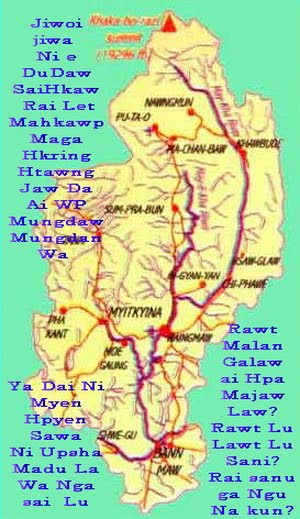
The junta will leave no stones unturned to win the elections. For starters the Burmese Army has promised to ferry 100,000 Burman voters to Kachin State from Burma Proper during the country’s yet undated countrywide elections late this year, military sources said. Then the new comers will be settled.
The Danai-based Regional Operation Command (ROC or da-ka-sa) has promised to systematically transport Burman people from Burma Proper and the 2008 Cyclone Nargis-hit areas in Irrawaddy River basin to Hukawng Valley in western Kachin State, said the sources.
In a two pronged strategy the Burmese military junta plans to transport 100,000 Burman voters to Kachin State to win the elections and then settle them to control the resource rich state. That the first step could tantamount to rigging the polls seems to be nobody’s concern.
The junta will leave no stones unturned to win the elections. For starters the Burmese Army has promised to ferry 100,000 Burman voters to Kachin State from Burma Proper during the country’s yet undated countrywide elections late this year, military sources said. Then the new comers will be settled.
The Danai-based Regional Operation Command (ROC or da-ka-sa) has promised to systematically transport Burman people from Burma Proper and the 2008 Cyclone Nargis-hit areas in Irrawaddy River basin to Hukawng Valley in western Kachin State, said the sources.
Kokang troops enter Kachin state from China surreptitiously
By KNG
Kokang troops, from Burma’s Shan State, who had escaped the Burmese Army’s onslaught in August last year and sheltered all this time in China’s southwest Yunnan province, surreptitiously entered Kachin State over 12 days ago said local sources.
The troops with about 300 fighters of Kokang Chinese ethnic origin, or the Myanmar National Democratic Alliance Army (MNDAA) entered territories under the control of the the Burmese Border Guard Force, former New Democratic Army-Kachin (NDA-K), eastern Kachin State, bordering China’s Yunnan province, said sources close to the rebel group.
Border-based military observers said, the Kokang troops entered three different places in separate batches in former NDA-K territories--- Pangwa, Kambaiti. Most of the troops entered N’Mai Hku, or also Hukone.
The troops are under the command of Peng Daxun, the eldest son of Peng Jia-sheng, leader of the Kokang, who is in hiding following a warrant by the Burmese junta, after the rebel capital Laogai was captured by Burmese troops in August, last year, said sources.
After the fall of Kokang territories, Peng Daxun’s troops fled to Chinese border town Nansan in Yunnan province opposite Kokang territories, where they were granted special shelters without their weapons being confiscated by the Chinese authorities, added sources close to the troops.
Kokang troops, from Burma’s Shan State, who had escaped the Burmese Army’s onslaught in August last year and sheltered all this time in China’s southwest Yunnan province, surreptitiously entered Kachin State over 12 days ago said local sources.
The troops with about 300 fighters of Kokang Chinese ethnic origin, or the Myanmar National Democratic Alliance Army (MNDAA) entered territories under the control of the the Burmese Border Guard Force, former New Democratic Army-Kachin (NDA-K), eastern Kachin State, bordering China’s Yunnan province, said sources close to the rebel group.
Border-based military observers said, the Kokang troops entered three different places in separate batches in former NDA-K territories--- Pangwa, Kambaiti. Most of the troops entered N’Mai Hku, or also Hukone.
The troops are under the command of Peng Daxun, the eldest son of Peng Jia-sheng, leader of the Kokang, who is in hiding following a warrant by the Burmese junta, after the rebel capital Laogai was captured by Burmese troops in August, last year, said sources.
After the fall of Kokang territories, Peng Daxun’s troops fled to Chinese border town Nansan in Yunnan province opposite Kokang territories, where they were granted special shelters without their weapons being confiscated by the Chinese authorities, added sources close to the troops.
Informal Sex Trade Threatens to Undercut Gains in HIV
By IRWIN LOY / IPS WRITER
PHNOM PENH — on a muggy evening, a handful of men in suits were quickly getting drunk in a beer garden here in the Cambodian capital. One man rested his hand on the thigh of a slender woman sitting uncomfortably in a short skirt.
A sign above the table read: "Be responsible. Use a condom."
"The customers play around with us all the time," said Neang, glancing at the scene unfolding at the next table. "They touch my breasts, or put their hands on my thigh while I’m sitting down. I don’t like it, but I have no other choice."
Beer promoters like Neang and others who work in places where Cambodia’s informal sex industry can be found are a growing concern for health experts in this Southeast Asian country, as sex work shifts from traditional settings like brothels to informal ones in the entertainment sector.
PHNOM PENH — on a muggy evening, a handful of men in suits were quickly getting drunk in a beer garden here in the Cambodian capital. One man rested his hand on the thigh of a slender woman sitting uncomfortably in a short skirt.
A sign above the table read: "Be responsible. Use a condom."
"The customers play around with us all the time," said Neang, glancing at the scene unfolding at the next table. "They touch my breasts, or put their hands on my thigh while I’m sitting down. I don’t like it, but I have no other choice."
Beer promoters like Neang and others who work in places where Cambodia’s informal sex industry can be found are a growing concern for health experts in this Southeast Asian country, as sex work shifts from traditional settings like brothels to informal ones in the entertainment sector.
Burma’s Nuke Ambitions to Come under Scrutiny
By MARWAAN MACAN-MARKAR / IPS WRITER
BANGKOK — When Southeast Asian foreign ministers gather in Hanoi this week for a series of annual security meetings, the region’s most troublesome member, military- ruled Burma, is due to come under scrutiny over reports of its nuclear ambitions.
Alarm bells have been going off in South-east Asian capitals since the early June expose by the Democratic Voice of Burma (DVB), an Oslo-based broadcasting station run by Burmese journalists in exile that reported that the Burmese junta intends to build nuclear weapons facilities.
Indonesia, the largest country in the 10-member Association of Southeast Asian Nations (Asean), is among those expected to seek an explanation from Burma during the meetings in the Vietnamese capital, which run from Jul. 20- 23.
BANGKOK — When Southeast Asian foreign ministers gather in Hanoi this week for a series of annual security meetings, the region’s most troublesome member, military- ruled Burma, is due to come under scrutiny over reports of its nuclear ambitions.
Alarm bells have been going off in South-east Asian capitals since the early June expose by the Democratic Voice of Burma (DVB), an Oslo-based broadcasting station run by Burmese journalists in exile that reported that the Burmese junta intends to build nuclear weapons facilities.
Indonesia, the largest country in the 10-member Association of Southeast Asian Nations (Asean), is among those expected to seek an explanation from Burma during the meetings in the Vietnamese capital, which run from Jul. 20- 23.
Building an Opposition to the Opposition
By AUNG MOE ZAW
It is popular today to say that Burmese civil society can be built without a struggle despite the present environment created and controlled by a military regime to ensure that people live according to their rules.
It is popular today to talk of engaging the regime which itself has refused to engage with the political party that won the last election and for whom meaningful engagement comes in twenty minute pseudo meetings with UN envoys.
It is also popular to suggest that foreign aid could open the door to a new society in Burma, even after those with bountiful aid for the disaster stricken delta after Cyclone Nargis were rejected and refused. Such views are popular among some intellectuals, a few political and NGO elites, and a few business people. It is the rhetoric of those who make up a “third force” in today's political culture.
It is popular today to say that Burmese civil society can be built without a struggle despite the present environment created and controlled by a military regime to ensure that people live according to their rules.
It is popular today to talk of engaging the regime which itself has refused to engage with the political party that won the last election and for whom meaningful engagement comes in twenty minute pseudo meetings with UN envoys.
It is also popular to suggest that foreign aid could open the door to a new society in Burma, even after those with bountiful aid for the disaster stricken delta after Cyclone Nargis were rejected and refused. Such views are popular among some intellectuals, a few political and NGO elites, and a few business people. It is the rhetoric of those who make up a “third force” in today's political culture.
Asean Urges Burma to Hold Free, Fair Election
By JIM GOMEZ / AP WRITER
HANOI — Southeast Asian foreign ministers urged Burma's military-run government to hold free and fair elections—a rare stand by the cautious group often accused of overlooking rights abuses in member nations.
Foreign ministers from the 10-member Association of Southeast Asian Nations began their annual meeting Tuesday in the Vietnamese capital of Hanoi to tackle a diverse agenda—from setting up a European-style economic community by 2015 to bolstering ties with the West and regional powerhouses China, Japan and India.
But at a dinner on the eve of the conference, Burma took center stage as diplomats vented their concerns about planned elections, which the junta has said will be held this year, without giving a date.
HANOI — Southeast Asian foreign ministers urged Burma's military-run government to hold free and fair elections—a rare stand by the cautious group often accused of overlooking rights abuses in member nations.
Foreign ministers from the 10-member Association of Southeast Asian Nations began their annual meeting Tuesday in the Vietnamese capital of Hanoi to tackle a diverse agenda—from setting up a European-style economic community by 2015 to bolstering ties with the West and regional powerhouses China, Japan and India.
But at a dinner on the eve of the conference, Burma took center stage as diplomats vented their concerns about planned elections, which the junta has said will be held this year, without giving a date.
Subscribe to:
Posts (Atom)